
Made to Thrive: How Solid Wood Furniture Survives — and Thrives — in Singapore’s Climate
Can solid wood furniture survive Singapore’s humidity and aircon?
Yes — if it is both stabilised to a 10–12% moisture baseline and built with artisanal joinery that lets it move. Drying alone isn’t enough; wood is hygroscopic and keeps responding to its environment for life.
Article Contents
1. The Quiet Worry — Navigating the fear of wood cracking in Singapore AC.
2. The Atmospheric Pendulum — Understanding the rapid ~84% to ~10–12% humidity swing.
3. Why Drying Is Only Part of the Answer — Why standard drying isn’t a permanent fix.
4. Part One: The Prepared Baseline — The science of establishing a 10–12% moisture foundation.
5. Part Two: Engineered to Breathe — Artisanal wood orientation, grain direction, and traditional joinery.
6. Thrives, Not Survives — Building bespoke timber masterpieces for a 50-year frame.
7. The Proof — The transparency of the WD Custom Woodcraft Commission Certificate.
8. Begin a Commission — How to start your custom furniture journey.
1. The Quiet Worry

It is a quiet but persistent anxiety that crosses the mind of anyone investing in fine furniture for a Singapore home: will solid wood actually survive the air-conditioning?
The fear is entirely reasonable. We have all seen the cautionary tales—gorgeous timber tables that warp, split, or crack after a few months of modern indoor living. But solid wood doesn’t have to be a fragile luxury. Handled with equal parts scientific discipline and master craftsmanship, it does not merely survive the tropical climate—it thrives for generations.
2. The Atmospheric Pendulum
To understand how to protect solid wood, we first have to understand the unique environmental stress it faces in Singapore. We call this extreme climate swing The Atmospheric Pendulum.
Outside, our furniture is exposed to a wet-tropics baseline of roughly 84% outdoor ambient relative humidity (RH). Yet, the moment we turn on the air conditioning, we pull that wood into a microclimate with an Equilibrium Moisture Content (EMC) of just 10–12%—an indoor environment akin to a desert.
Environmental Metric | Value (Approx) | Climate Impact |
Outdoor Ambient Humidity (SG) | ~84% RH | The wet-tropics baseline |
AC Interior EMC | ~10–12% EMC | The dry “desert” the wood is pulled toward |
SG Air-Dry Stall | ~15–18% MC | Why air-drying alone is insufficient here |

Wood is a biological medium. Long after it leaves the tree, it never stops breathing—it is hygroscopic, forever seeking equilibrium with the moisture in the air around it. When the air is drier than the wood, the wood releases moisture and contracts. When the air is wetter, it absorbs moisture and expands.
In most climates, this is a gentle, seasonal conversation. In Singapore, it is a daily extreme. A single piece of furniture lives on both ends of that arc at once—pulled toward the humid outdoors and the air-conditioned desert in turn. Cycled between the two daily, the wood is caught in an invisible, structural tug-of-war. This is precisely why wood cracks and warps in Singapore air conditioning when it hasn’t been prepared for the strain.
3. Why Drying Is Only Part of the Answer

It is tempting to assume that “kiln-dried” timber settles the question for good. It doesn’t—not because the drying was done poorly, but because of what wood is.
Drying lowers only where the wood starts; it cannot change what the wood is. It is the baseline, not a finish line. Because of Singapore’s climate, local air-drying stalls out at 15–18% Moisture Content (MC). For many, that reads as “dry”, but it is still far too high for an air-conditioned room. Relying on drying as a “one-time fix” ignores the fundamental nature of timber. Ongoing mitigation must be designed right into the DNA of the furniture itself.
4. Part One: The Prepared Baseline
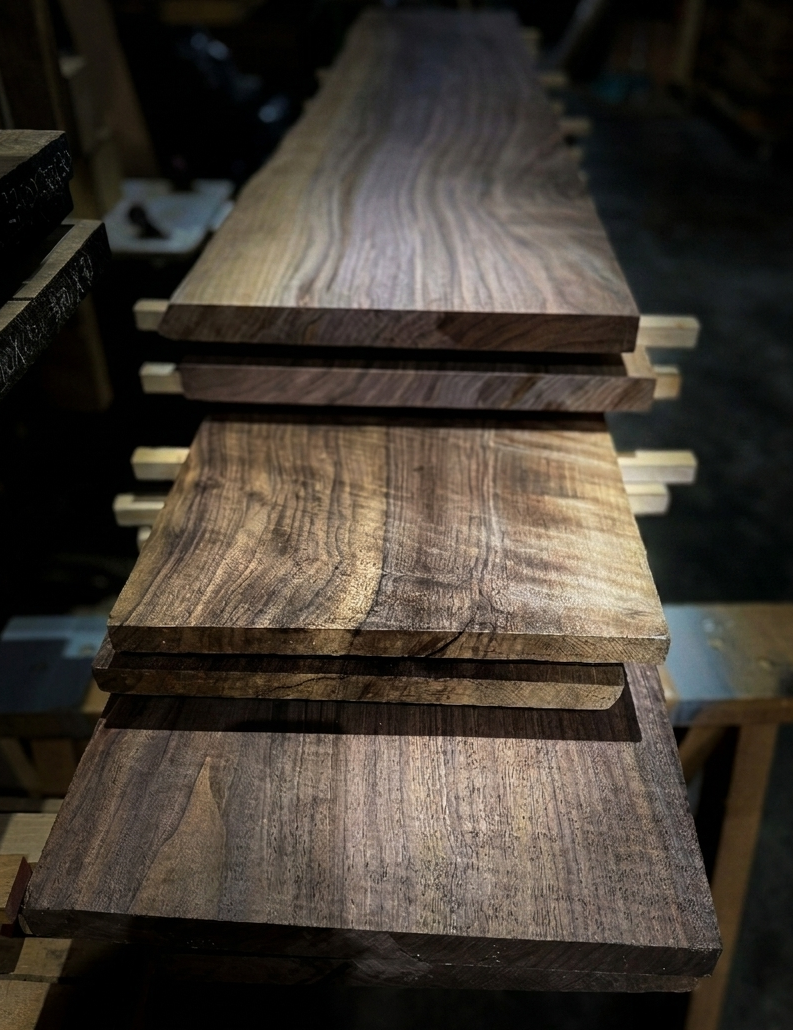
The first part happens before a single cut is made. We begin by establishing a prepared baseline.
At WD Custom Woodcraft, we stabilise our timber to a strict 10–12% Moisture Content (MC) baseline. This ensures that when the finished piece enters an air-conditioned home, its internal moisture levels align closely with the dry interior EMC.
Achieving this stable, square stock is a demanding process. We see roughly a 65–70 board foot yield from every 100 board feet (BF) of green lumber, meaning a significant portion of raw timber is sacrificed to ensure only the most resilient, stable wood makes it to the workbench. But this stabilisation baseline is just the foundation—it is not a cure on its own. (Learn more about that journey: The Path to Heritage.)
5. Part Two: Engineered to Breathe

If stabilisation is the science, the joinery is the art. You can never truly stop solid wood from moving; a master artisan knows that you must instead give it the freedom to do so safely.
Long before air conditioning, traditional woodworkers perfected the techniques required to handle timber’s natural movement. At WD Custom Woodcraft, we lean on that artisanal architectural joinery—designed to work with the wood’s movement rather than restrain it. Held rigidly, the tension of Singapore’s Atmospheric Pendulum has nowhere to go; our techniques give it somewhere to go.
The Strategy of Grain Direction and Board Orientation

Engineering a masterpiece to breathe begins at the design phase with careful material layout. Wood expands and contracts significantly more across its width than along its length. Our designers plan grain direction for structural strength and to minimise wood movement. Our craftsmen select board orientation to counterbalance cupping and warping forces. Boards and panels can thus expand across their width without placing destructive pressure on the supporting elements.
Time-Tested, Dynamic Joinery
With the wood properly oriented, we turn to the joints themselves.

By utilising floated panels, a central timber surface sits securely inside a grooved frame without being permanently glued down. When the Atmospheric Pendulum swings from a humid afternoon to a chilled, air-conditioned evening, the panel imperceptibly shrinks and expands within its channels, completely unhindered.
Similarly, we integrate traditional breadboard ends—narrow strips of wood attached perpendicularly to the ends of the main tabletop using specialised, hand-fit mortise-and-tenon joints. This heritage technique acts as an elegant structural cap that holds the wide boards flat while allowing them to expand and contract across their width without splitting.
We also use dynamic fasteners—Z-clips or figure-of-eight fasteners in slotted holes—to secure tops to frames: they hold the piece firm while letting it glide fractionally side to side. The result is furniture that breathes safely with Singapore’s air conditioning. (The mechanics, in full: Architectural Joinery: Engineering for Movement.)
6. Thrives, Not Survives

When you combine an exact, climate-matched moisture baseline with master-level architectural joinery, something remarkable happens. Solid wood stops being a liability in the tropics.
We do not build for the showroom floor; we build for a 50-year frame. An heirloom-quality piece should withstand decades of daily life and thousands of air-conditioning cycles. Each masterpiece requires anywhere from 80 to 360 man-hours of elite labour in our Tagore workshop. This deliberate, slow-craft approach transforms raw timber into a legacy asset that matures beautifully alongside your home. What you are left with is not furniture that tolerates its environment, but furniture entirely at home in it—an heirloom, made once, for you, built to be handed on.
7. The Proof

We believe that fine craftsmanship should be verifiable, not just promised. Every original piece that leaves our workshop is accompanied by an official Commission Certificate. The stability of your piece is not a claim we make; it is a measurement we document and hand to you with the work. This document is a permanent record of your furniture’s verified moisture baseline—the proof that the piece was stabilised to meet your home before the first joint was cut. It is our transparent assurance that the science behind your piece matches the heritage of the craft.
8. Begin a Commission
Solid wood was never the problem—it just needed to be understood. Creating a piece of solid wood furniture that thrives in Singapore requires a rare alignment of environmental physics and artisanal craftsmanship.
If you are ready to introduce a beautifully engineered, enduring piece of natural history into your space, we invite you to take the first step.
Book a consultation with our design team or explore our ongoing workshop journals to see how we bring these structural masterpieces to life.
Frequently Asked Questions
Can solid wood furniture survive Singapore's humidity and air-conditioning?
Yes. Properly prepared solid wood thrives in Singapore's climate. The approach is two-part: stabilising the timber to a 10–12% moisture-content baseline that matches an air-conditioned interior, and building with joinery engineered to accommodate the wood's natural movement. Drying alone is a baseline, not a cure — wood remains hygroscopic and keeps responding to its environment, so the joinery must let it move without cracking or warping.
Why does solid wood crack or warp in an air-conditioned home?
Wood is hygroscopic — it absorbs and releases moisture as the surrounding air changes. In Singapore, furniture swings between humid outdoor air of around 84% relative humidity and dry, air-conditioned interiors. Each shift makes the wood expand and contract. When a piece is built rigidly, with no allowance for that movement, the stress has nowhere to go, and the wood cracks, warps or splits. The movement is normal; the failure comes from building as though it will not happen.
Does drying wood permanently stop it from moving?
No. Drying establishes a baseline moisture content, but it does not lock the wood in place. Wood is hygroscopic and will always re-equilibrate towards the humidity around it, which is why drying alone is never a complete answer. Furniture built to last in the tropics pairs a stabilised 10–12% baseline with joinery engineered to let the wood breathe — expand and contract — with the Atmospheric Pendulum that us the Singapore air-conditioned home.
What moisture content should solid-wood furniture be at for Singapore?
For an air-conditioned Singapore interior, solid wood is best stabilised to a 10–12% moisture-content baseline. This matches the equilibrium moisture content of a typical air-conditioned room, so the timber enters the home already close to the conditions it will live in, minimising the movement it must make once in place. Air-drying alone in Singapore tends to stall around 15–18% because of our high relative humidity, which is too high for an air-conditioned interior.
How is solid wood furniture made to thrive, rather than just survive, in the tropics?
Through scientific preparation and craft. Each piece begins with timber stabilised to a 10–12% moisture baseline, then is built with movement-accommodating joinery — floating panels, sliding dovetails and breadboard ends — that lets the wood expand and contract without stress. The result is furniture that settles into an air-conditioned home and stays sound for generations, rather than a piece that is merely held together and hoped for.
Can I commission solid-wood furniture directly from the craftsman?
Yes. You can commission a bespoke solid-wood piece directly from the atelier — made once, for you. Working directly with the maker means the timber, joinery and finish are chosen for your home and its conditions, and each commission is documented in a Commission Certificate that records its moisture readings, joinery and finish, so its preparation and provenance are verifiable.

Comments