
What does your furniture say about you?
What does your furniture say about you?
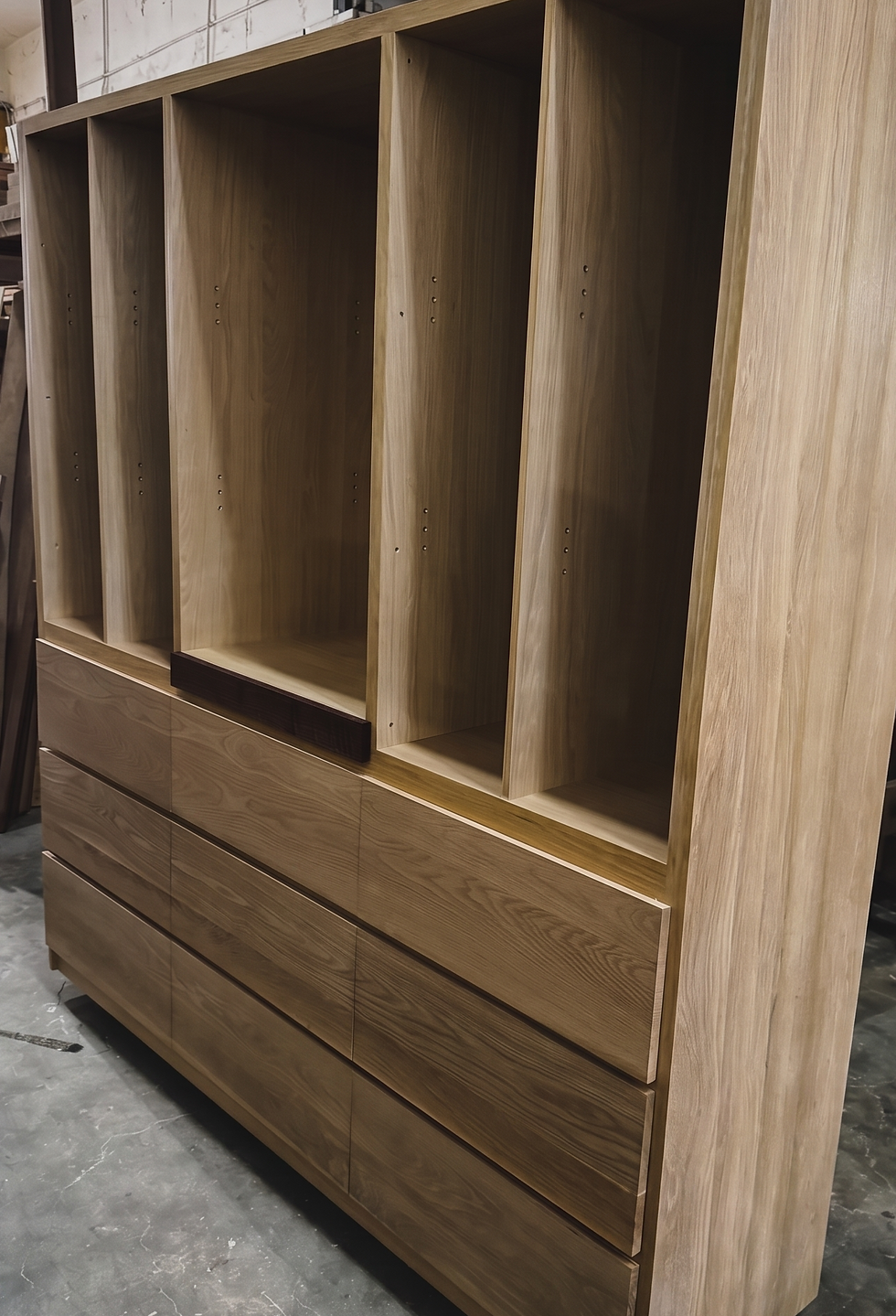
It says how you choose. A commissioned solid-wood piece — designed with you, made once, engineered to move with Singapore's climate — says its owner chose deliberately: one maker, your piece, built to outlast the room it stands in.

Article Contents
— The Quiet Signal — What a piece of furniture communicates before anyone sits down.
— Four Ways to Furnish a Room — Mass-produced, designer retail, antique, and commissioned — and what each one says.
— The Fourth Way, Up Close — What it means to commission solid wood directly from the maker.
— Where a Commission Begins — The journey, from first message to delivery.
— What You Are Actually Buying — Joinery engineered to move, and the Commissioning Certificate that proves it.
— Begin the Conversation — How to start.
1. The Quiet Signal
Every piece of furniture in a home is saying something. Not loudly — furniture rarely speaks loudly — but constantly, to everyone who enters the room, and most of all to the person who lives with it.
A dining table says something about how a family gathers. A cabinet says something about what its owner considers worth keeping. And the way a piece was made — where it came from, who shaped it, how long it was intended to last — says something about how its owner makes decisions.
This is the question that sits underneath every furnishing choice, long before price enters the room: what do I want this piece to say?
There is no single right answer. But there are four distinct ones.
2. Four Ways to Furnish a Room
Broadly, a room in Singapore is furnished one of four ways. Each is a legitimate choice. Each says something different.
The way | What you receive | What it says |
Mass-produced (flat-pack, online marketplaces) | Immediate function at accessible cost, replaced easily as life changes | Practicality. This season of life is served well, and the piece is not asked to outlive it |
Designer retail (established international houses) | A recognised name, a showroom-finished design, produced in series | Curation. An eye for established taste, selected from what the world already makes |
Antique and refurbished | A piece with a past, restored to carry on | Patience. A respect for history, and the willingness to live with what time has already shaped |
Commissioned solid wood | A piece that did not exist until you asked for it — designed with you, made once, engineered for the room it will live in | Authorship. The piece answers to no showroom and no series. It was made for you, and it will outlast the room |

The first three are well understood. Most people in Singapore have furnished a home from at least one of them.
The fourth is the one most people do not know exists.
Q: What is the difference between commissioned furniture and designer retail furniture?
A: Designer retail is selected from a series that already exists. A commission does not exist until it is asked for — it is drawn to a specific room and built once.
3. The Fourth Way, Up Close
There is a persistent assumption that commissioning furniture is something other people do — that between an individual and a craftsman there must stand a showroom, a catalogue, an interior designer, a middle layer of some kind.
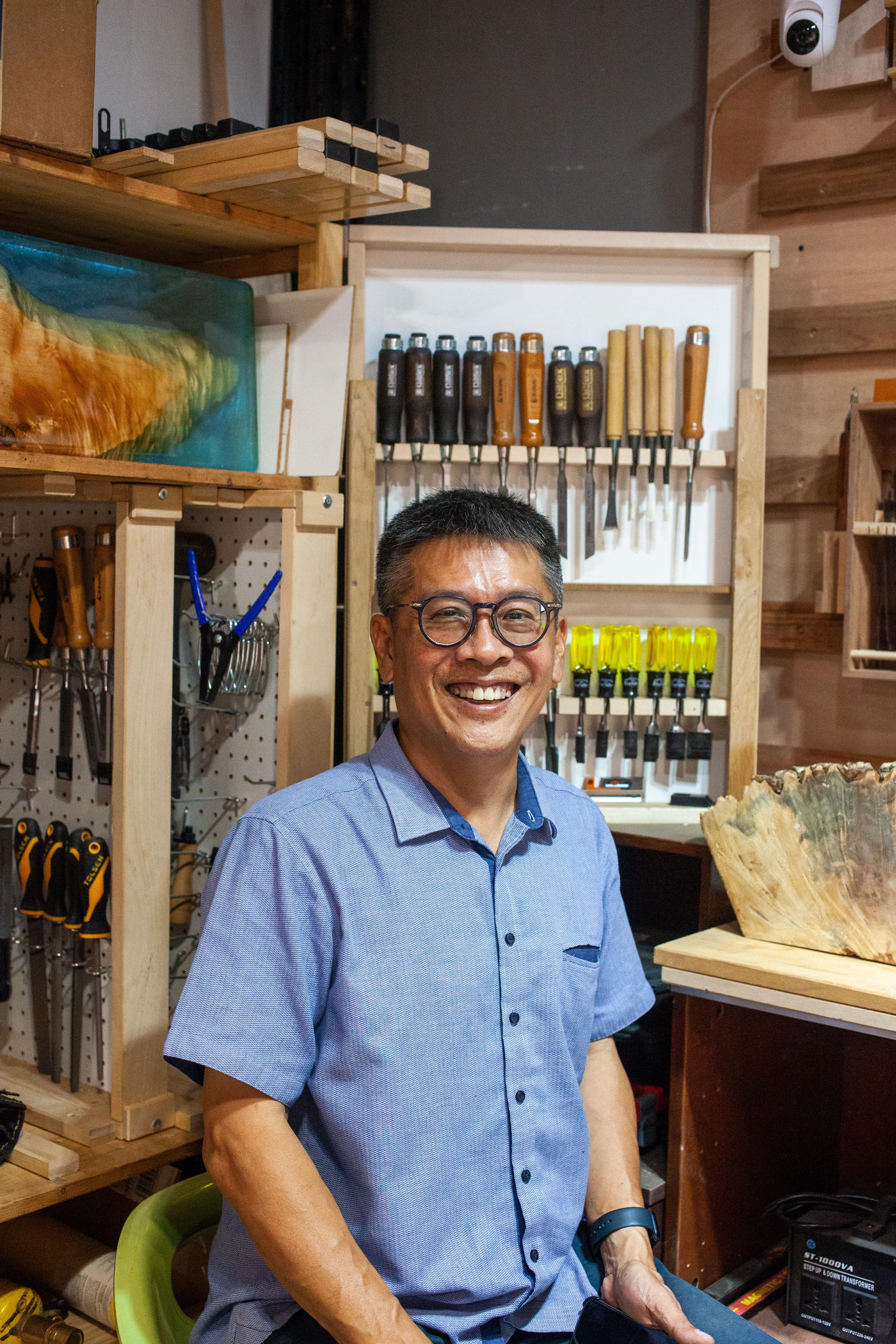
There doesn't. You can commission a piece of solid-wood furniture directly from the workshop that will build it. You sit with the people who will select the boards, cut the joints, and fit the drawers. The design begins with your room, your proportions, your decor, your emotions — not with what a production line already tooled for.
And in Singapore, commissioning from the maker carries a second meaning that matters more here than almost anywhere else: the piece is engineered, from the first drawing, for the climate it will live in. (Wood Depot has written the definitive account of that climate: The Atmospheric Pendulum.)

Solid wood is a biological medium; it never stops responding to the air around it. In a Singapore home — humid air outside, air-conditioned dryness inside — that response never settles. A piece built without regard for this will show it. A piece engineered for it will not merely endure the environment; it will be entirely at home in it. That engineering is a discipline of its own — we’ve written about the science of it in Made to Thrive and the mechanics of it in Architectural Joinery.
A commissioned piece, then, says two things at once. That it was made for you. And that it was made for here.
Q: Can you commission furniture directly from a craftsman in Singapore?
A: Yes. A commission can begin with a direct message or a walk-in to the atelier that will build the piece. The design starts with your room and your proportions rather than with an existing production line.
4. Where a Commission Begins
The journey is more straightforward than most people expect. It begins with simply a conversation.
How do you commission solid-wood furniture directly from the maker?
1. You contact us — a message on WhatsApp, or book an appointment at our workshop. Better yet, simply walk in and have a chat.
2. We advise — on your space, your use, what works and, just as honestly, what doesn't. Not every idea should be built in solid wood, and we will say so.
3. We draft a design — proportioned to your room, engineered for movement from the first line.
4. We quote — for that design, that timber, that piece.
5. You confirm and place a deposit — and the piece enters the workshop.
6. We produce — board selection, joinery, assembly, finishing, each stage in its own time.
7. We deliver — the piece arrives in your home, accompanied by its documentation.
At every stage before the deposit, you are simply in a conversation. Nothing is owed for asking.
5. What You Are Actually Buying
A commission is not a faster or slower way of buying a table. It is a different object altogether, and two things define it.

The first is joinery engineered to move. Solid wood cannot be stopped from moving; it can only be given somewhere safe to go. Floated panels that shrink and swell inside their frames. Breadboard ends that hold a wide top flat while letting it breathe across its width. Fasteners that glide fractionally rather than fight. This is architectural joinery — the reason a piece built here in the 2020s can still close cleanly in the 2070s. (The full mechanics, if you're curious.)
Q: Does solid wood furniture survive Singapore's humidity and air-conditioning?
A: Solid wood never stops responding to the air around it, and in a Singapore home that response never settles. A piece survives it by being built from timber prepared to a stable moisture baseline and joined so the timber can move — not by being sealed against movement.
The second is the Commissioning Certificate. Every original piece that leaves our workshop carries one. It records, among the piece's particulars, its verified moisture content measured before finishing — the documented proof that the timber was matched to the environment it was built for, not merely described as such. Stability is not a claim we make about your piece; it is a measurement we take, record, and hand to you with the work. It is also part of what turns a piece of furniture into something that can be handed on — an object with its own papers. (Why that matters over a lifetime: The Path to Heritage.)
Between the two — the joinery and the certificate — a commission arrives with something no showroom piece carries: an account of itself.
6. Begin the Conversation
What your furniture says about you was never really a question of cost. It is a question of authorship — of whether the objects you live with were chosen from what exists, or brought into existence because you asked.
Message us on WhatsApp to start a conversation — about a room, an idea, or simply a question. Or come and see the work in progress; we are always glad to show a joint before it disappears inside a finished piece.


Comments